Power Pumping to Increase Milk Supply (Complete Schedule)
If you've been staring at the pump thinking why the bottles aren't filling up the way they used to, or the way you hoped, you are not the only one. Low milk supply is one of the most common worries among new mothers in India, and the internet offers a flood of advice, most of it vague. Don’t worry, this will be the last one you will read and then you will be sorted. Here we explain exactly what power pumping is, how to do it, what schedule works best, which pump to use, and, most importantly, what Indian mothers in our Mom Insider community have experienced firsthand.
Table of Content
What Is Power Pumping?
Does Power Pumping Work?
Power Pumping Schedule
How to Power Pump with a Single Electric Pump
How to Increase Milk Supply Fast
Pros and Cons of Power Pumping
Power Pumping for Exclusive Pumpers
What Is Power Pumping?

Power pumping is a technique where you use a breast pump in repeat over the course of one hour, mimicking the way a baby cluster feeds during a growth spurt. The goal is to send a demand signal to your body, prompting it to produce more milk in upcoming days.
The science behind it is simple. Breast milk production works on a supply-and-demand basis. The more your breasts are emptied (or stimulated), the more milk your body makes. When a baby cluster feeds, nursing every 30 to 45 minutes for a stretch, it's doing what power pumping is doing artificially. Power pumping is not a magic fix. It works over days, not hours. But for many mothers, it is the turning point.
Growth Spurt - It is a short period when a baby suddenly grows and develops quickly, often leading to increased hunger, more frequent feeding, fussiness, or changes in sleep.
Who should consider power pumping:
Mothers seeing a drop in supply
Exclusive pumpers who want to increase output
Working mothers returning to the office and building a freezer stock
Mothers whose babies have latching difficulties and are fully or partially pumping
Anyone who has been told their supply is low and wants to try this before moving to formula
Does Power Pumping Work?
Yes, and the evidence comes from both lactation science and the experiences of thousands of mothers. From a physiological point of view, frequent breast stimulation increases prolactin levels, the hormone responsible for milk production. Power pumping triggers repeated prolactin levels over one hour, which over several days trains the body to produce more milk.
Prolactin - It is a hormone produced by the body that helps stimulate and maintain breast milk production after childbirth.
Is power pumping effective for everyone?
Not really. Results depend on several factors like how consistently it's done, the timing of sessions, the pump being used, your overall hydration and stress levels, and how long supply has been low. But mothers who do it consistently for 5-10 days, says that they saw a measurable increase.
What do mothers say?
In our mom Insider community, one mother shared, “ I did it once for 7-10 days and saw a major increase in supply. Lactation consultant had asked me to do it thrice a day but it was not feasible. Do it for a few days if it's possible for you.”
Another mother from our community shared a detailed formula that helped her move from partial formula top-ups to exclusive breastfeeding: "I did 2 power pump sessions, one at 2AM and one at 5AM. It's a slow process of increase. Please don't stress yourself out and trust your body."
How long does power pumping take to work?
Most mothers begin to see a noticeable increase within 3-7 days of consistent daily sessions. Some see a difference as early as 48 hours. Few mothers said they needed 10-14 days. The key is consistency, skipping days resets the demand signal.
Power Pumping Schedule: Step-by-Step
The standard power pumping schedule looks like this:
The Classic 20-10-10-10-10 Schedule
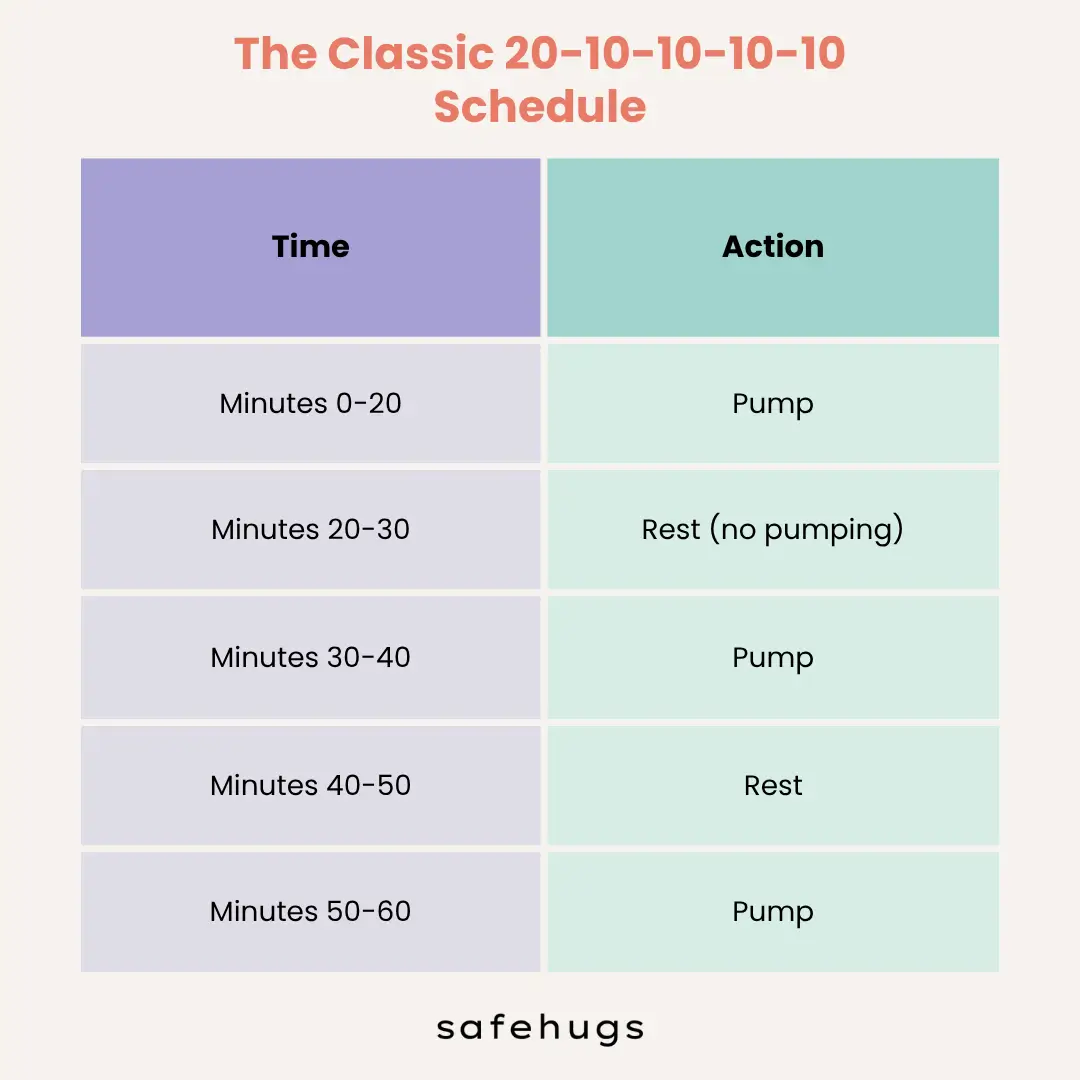
The entire session takes one hour. You pump for a total of 40 minutes across three bursts, with two 10-minute rest breaks in between. During the rest breaks, you do not need to stay attached to the pump. Use that time to drink water, eat something, or simply breathe.
When is the best time to power pump?
Early morning, between 2 AM and 6 AM, is when prolactin levels are naturally highest. This makes morning the most productive time for a power pumping session. Many experienced mothers in our Mom Insider community recommend a session between 2 AM and 5 AM, mainly for mothers who are exclusively pumping. If an overnight session is not possible, the next best time is first thing in the morning after your baby's early feed. Avoid doing your power pumping session in the afternoon when prolactin levels tend to be low.
How many times a day should you power pump?
Once a day is enough for most mothers to see results, especially if doing it consistently over 7-10 days. A lactation consultant may recommend two to three sessions daily, but that level is difficult to sustain alongside caring for a newborn.
How many days should you power pump?
Aim for 3-5 consecutive days as a minimum. A week of daily sessions is the most commonly recommended duration. After that, you can reduce to 2-3 times a week to maintain the supply increase.
How to Power Pump with a Single Electric Pump
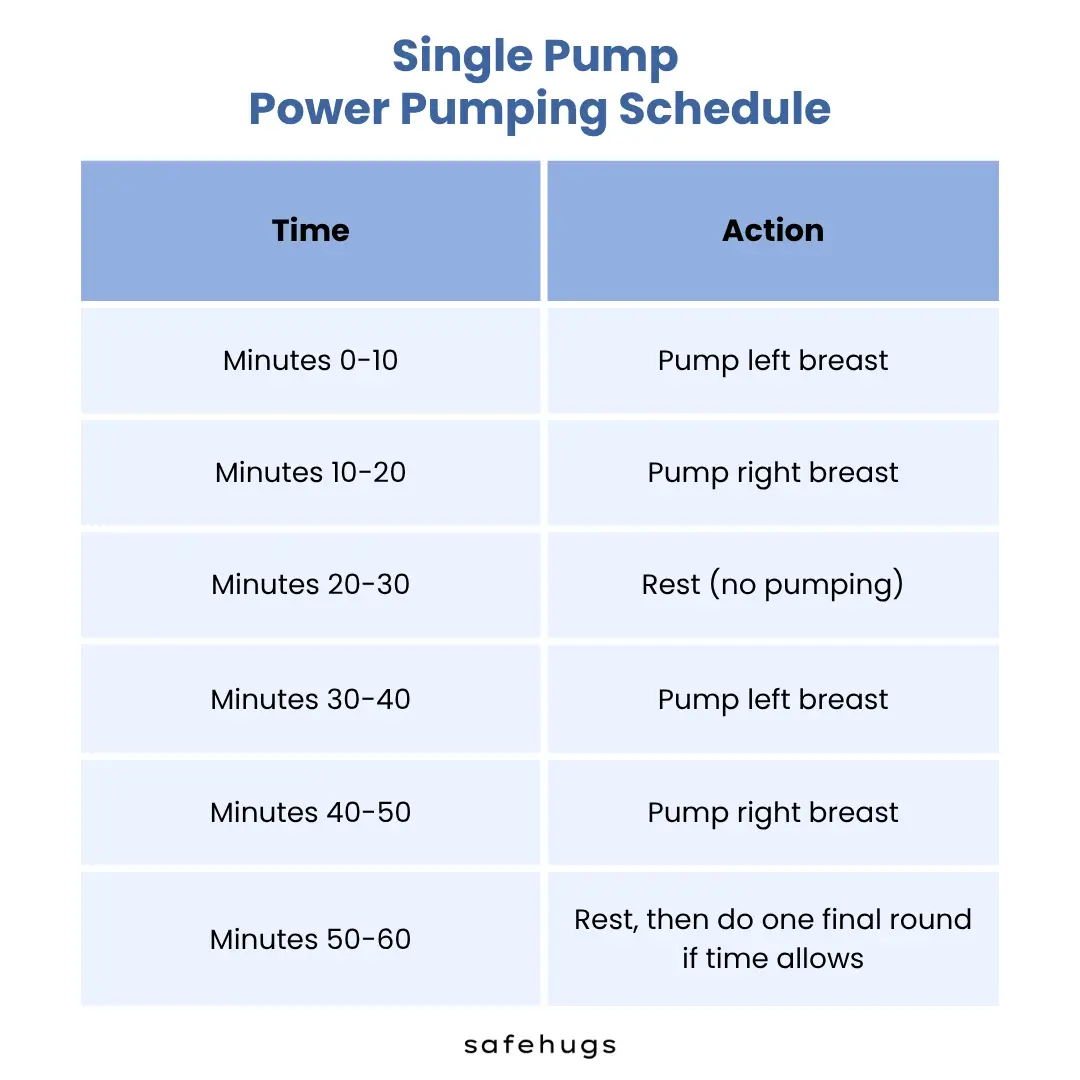
You do not need a hospital-grade double pump to power pump. A single electric pump works, it just requires alternating between breasts during the session.
Single pump power pumping schedule:
This takes slightly longer to set up each rotation but is equally effective at generating the demand signal.
What about wearable pumps?
Wearable pumps like the Promom or Elvie are convenient, but our community is consistent on this point: "Imo, the wearable pumps only work for people with good supply or those who want to pump once in a while." For power pumping sessions where you need strong, consistent suction across an hour, a corded or rechargeable pump like the Spectra S1 is significantly more effective.
Spectra power pumping settings
The Spectra S1 and S2 are among the most recommended pumps in our Mom Insider community, and for good reason. They offer adjustable suction and cycle settings, which is important for power pumping.
Flange (breast shield) size matters
Before power pumping, verify you are using the correct flange (breast shield) size. The wrong size reduces efficiency and can cause discomfort that makes the session unsustainable. Note that your left and right breasts may require different sizes. Most mothers need a 24mm or 28mm flange and some need as small as 21mm or as large as 32mm. A sign your flange is too small is your nipple rubs against the tunnel walls and too large when areola tissue is being pulled in excessively.
Signs Your Milk Supply Is Decreasing
It helps to know whether your supply is actually dropping or whether you're experiencing normal variation. Here are the genuine signs to watch for:
Signs that suggest a real supply drop:
Baby seems unsatisfied after long nursing sessions and is feeding more frequently than usual
Noticeably fewer wet and dirty nappies per day (fewer than 6 wet nappies after day 5 of life is a concern)
Baby is not gaining weight adequately
You are pumping significantly less than you were one to two weeks ago
Breasts do not feel full at all between feeds for several days in a row
The soft breast myth
Many mothers panic when their breasts feel soft and assume they have no milk. This is one of the most common misconceptions in new parenthood. Soft breasts do not mean empty breasts. In the early weeks, breasts feel full and engorged because your body is still regulating supply. By weeks 6-8, most mothers' breasts soften as supply and demand sync up. A softer breast at a regular feeding time is often a sign of a well-regulated, healthy supply, not a drop. Supply does fluctuate naturally through the day and across the menstrual cycle. One bad pumping session does not mean your supply has fallen. A consistent downward trend over several days is what to look out for.
How to Increase Milk Supply Fast
Power pumping works best as part of a long term approach. Here is what the evidence, and mothers recommend to increase supply fast:
1. Hydration comes first
Breast milk is largely water. If you are dehydrated, your supply will feel it. Aim for at least 2.5-3 litres of water a day. Drink a full glass of water just before each feeding or pumping session, this is a practical tip that several community members swear by.
2. Do not cut carbohydrates
Indian diet culture sometimes pushes new mothers to "eat light" or cut rice and rotis. For breastfeeding, this is counterproductive. Your body needs sufficient carbohydrates to support milk production. Eat balanced, complete meals. Dal, rice, vegetables, and adequate protein are your friends.
3. Galactagogues that Indian mothers use
These are foods and supplements traditionally used to support milk supply:
Shathavari: Available as granules or capsules. Widely used and generally considered safe. Add granules to warm milk or ladoos.
Lactare tablets: A commonly prescribed supplement in India. Multiple moms from our Mom Insider community found them helpful, though most felt power pumping had a greater direct impact on supply.
Fenugreek (methi): Seeds, leaves, or ladoos. A traditional galactagogue, though effectiveness varies.
Oats, jeera water, gondh ke ladoo: Traditional postpartum foods with supply-supporting benefits.
4. Rest is not optional
This is the advice every new mother receives and the one most often impossible to follow. But it matters physiologically, cortisol (the stress hormone) suppresses prolactin. Sleep deprivation and chronic stress directly affect milk supply. Accept help. Assign all household tasks to a partner, family member, or help. Your only jobs are to feed the baby, sleep when possible, and stay hydrated.
Worried about low milk supply? Discover natural, evidence-based ways to increase breast milk supply.
Pros and Cons of Power Pumping
Everything is not right for every mother. Here is an honest view:
Pros of Power Pumping
Proven to increase supply when done consistently over 5-10 days
Flexible timing, once a day is enough and no need for the brutal triple-session schedule
Works with a single pump, no need to invest in expensive equipment
Compatible with both breastfeeding and exclusive pumping
Free, no supplements or products required
Cons of Power Pumping
Time intensive, one hour is a significant block of time with a newborn
Physically tiring, especially with sleep deprivation
Emotionally discouraging if nothing comes out at first
Not instantly effective, requires several days of consistency before you can see results
Can feel mechanical and create anxiety when measuring output
Power pumping vs cluster pumping
Cluster pumping means pumping more frequently throughout the day, for example, every 30-45 minutes for 3-4 hours. Power pumping does the same in one structured hour. Both work on the same principle. Power pumping is more time-efficient for a single block, and cluster pumping can be gentler if your nipples are sore but requires more attention. Some mothers rotate between both strategies in a single day.
Feeding every hour and wondering if it’s normal? Learn what cluster feeding is, why it happens, and how to handle it.
What If Nothing Is Coming Out?
This is one of the most common and most lowest experiences in power pumping, mainly on the first few sessions. You sit attached to the pump for an hour and get barely a few drops. But keep going. The drops are not the point. The stimulation is. Power pumping in the early stages is about sending the signal, telling your body that demand is high. Your body might take 48-72 hours to respond with increased production. Some mothers see results on day three while others on day seven.
Practical tips for sessions that feel unproductive:
Apply a warm cloth to your breasts for 5 minutes before starting
Do breast massage during the rest breaks
Look at a photo or video of your baby on your phone, oxytocin release can trigger a letdown
Make sure your flange size is correct because poor fit kills output
If you are consistently getting nothing after 10-14 days of daily power pumping, consult a lactation consultant. There may be an underlying cause, glandular tissue issues, medication effects, or hormonal factors, that requires professional assessment.
Letdown Reflex - It is the natural release of breast milk from the breasts, triggered when a baby suckles or when the body responds to thoughts, sounds, or feelings related to the baby.

Power Pumping for Exclusive Pumpers
If you are exclusively pumping, whether by choice or because of latching difficulties, power pumping will be well-suited to your routine, because you are already pumping on schedule and can slot a power pumping session in without disrupting a breastfeeding rhythm.
For exclusive pumpers, the recommended approach is:
Maintain your regular pumping schedule (every 2.5-3 hours during the day)
Replace one of those sessions with a power pumping session, do not add it on top of every other session or you will burn out
Track output over a week to spot the trend (increase, stable, or continuing decline)
Pump to drain, and not to measure a number
Power Pumping at Work
Returning to work while breastfeeding or pumping is one of the most challenging changes. Power pumping at the office is generally not realistic during work hours, the one-hour block is hard to take out.
Practical approach for working mothers:
Do your power pumping session before leaving for work (early morning is ideal anyway, aligns with high prolactin)
At work, maintain regular 2.5-3 hour pumping intervals to protect supply
Use a hands-free pumping bra at work for efficiency
Store milk at 4-5°C in a refrigerator, it stays safe for 5 days at that temperature
If no fridge is available, a good cooler bag with an ice pack keeps milk safe for up to 4 hours
Label every bag or bottle with date and time pumped. Many mothers use breast milk storage bags (available easily online in India) for freezer stash, they take up less space than bottles.
When to See a Lactation Consultant in India
If supply has been dropping for more than a week, if your baby has never latched even after multiple attempts, or if power pumping has not shown results after 10 days, see a lactation consultant.
In Bangalore, moms from our Mom Insider community have referenced consultants at Fortis Banerghatta Road. Major cities like Mumbai, Delhi, and Chennai also have lactation consultant practising independently or through hospitals. Ask your gynaecologist or paediatrician for a referral, or search the ILCA (International Lactation Consultant Association) directory online. A lactation consultant can assess latch, check for tongue tie, and advise on pump fit.
A Final Word
Breastfeeding in India comes with it's unique set of pressures, from paediatricians and gynaecologists with different advice, from family members, and from the internal voice that says you are not doing enough. You are doing enough. Supply challenges are common, manageable, and not a reflection of your commitment or your body's worth. Power pumping is one of the most effective tools available to you, which is backed by science and by the experiences of thousands of mothers who have been exactly where you are. Do it consistently, rest as much as you can, drink your water, eat your rice, and give your body time to respond. The supply almost always comes. Prioritise your sanity alongside it.
Related:
Check out "What Is Cluster Feeding".
Check out "Signs of Cluster Feeding".
Check out "How to Start Breastfeeding After a C-Section".
Check out "Wrong Breastfeeding Positions".