
What Is Cluster Feeding? Everything New Moms Need to Know
You may experience cluster feed when your newborn is feeding almost all the time and more so during evening and night. Newborns require regular feeding mostly 2 to 3 hours, but cluster feeding differs from this usual frequency. It can be a difficult time, knowing that it is normal for babies to cluster feed and how you can respond to it can help you smoothen this process.
Related:
What is Cluster Feeding?
Why Does Cluster Feeding Happen?
When Does Cluster Feed Happen
Signs Your Baby is Cluster Feeding
How Long Does Cluster Feeding Last
Cluster Feeding and Your Milk Supply
Cluster Feeding vs Formula
Cluster Feeding and Reflux
Cluster Feeding and Sleep
What is Cluster Feeding?
Cluster feeding refers to a pattern of breastfeeding where your baby has several short feeds spaced together than you expect. Throughout the first few days after your baby has been born, cluster feeding is very common. More frequent feedings are typical feeding for older babies at any specific time or when they need comfort. But beyond the first week, cluster feeding shouldn’t happen all day, every day. Constant cluster feeding might be due to temporary drop in the milk supply or latch issues. Understand that it is due to a temporary drop in milk supply, not a total drop.

Why Does Cluster Feeding Happen?
There are many reasons why babies cluster feed, but understanding the reasons behind cluster feeding won't make the exhaustion disappear, but it will make it easier to lean into rather than fight against.
Tiny Tummy Size
A newborn's stomach is very small, and can only hold a little amount of milk at a time. Your newborn will probably consume 2 to 10 ml of milk every feed during the first 24 hours after delivery. So they need to feed often to get full nourishment. By the end of the first week, they can take in 1 to 2 ounces per feeding. Now their tummy is full, and you don’t need to constantly feed them.
Growth Spurts
The most common reason babies cluster feed is that they are growing fast. In the early months, your baby's brain and body are developing at a pace that will never happen again in their lifetime. They need more calories to fuel that growth, and cluster feeding is how they get them.
Growth Spurts - It is a short period when a baby or child grows rapidly in height, weight, or development.
Milk Supply Regulation
Breastfeeding works on supply and demand. The more your baby feeds, the more your body is signalled to produce. When your baby cluster feeds, they are programming your supply for the weeks ahead. This is especially important in the first few weeks when your supply is still being established.
Comfort and Closeness
Breastfeeding not only gives babies the nutrients they need, but it also gives them comfort especially in the early weeks when everything outside the womb is new to them. Therefore if your baby is angry or feeling ill, they might want to nurse more frequently than usual.
Evening Fussiness
There is a reason cluster feeding peaks in the evenings. Babies are more alert and stimulated throughout the day, and by evening they are overwhelmed and overstimulated. Feeding is how they regulate, it is soothing, and calming. Your milk composition also changes slightly in the evening, with higher fat content, which helps satisfy and settle baby for longer stretches of night sleep.
A Natural Drop in Prolactin Level
Prolactin is a hormone that tells your body to secrete more milk. When you are nursing, changes in prolactin levels are normal, and expected. It will be lowest in the evening, and it might be a reason for cluster feeding to be more prominent in evenings.
Improper Latch
A latch is when your baby attaches to your nipples and areola when nursing. If it is not done properly, babies might not take enough milk. This will lead to cluster feeds, it is temporary and it can be resolved through proper latching.
When Does Cluster Feed Happen
Cluster feeds don’t have a schedule, that being said there are common windows where cluster feeding is most commonly seen.
First few days after birth - as your baby adjusts to the world and your milk comes in
Around 3 weeks - an early growth spurt
Around 6 weeks - another common growth spurt window
Around 3 to 4 months - a significant developmental leap
16 weeks and beyond - yes, some moms said it can still happen this late
Signs Your Baby is Cluster Feeding
Not sure what you are experiencing is cluster feeding? Here are the signs to look out for.

Feeding every 20 to 30 minutes for hours
Rooting, restlessness, sucking on fists or fingers
Screaming and high pitched cry
Fussing and making squeaky noise
Opening their mouth as if to feed
Wiggling from side to side
Moving hands and legs
Intermittent crying
Latching and unlatching repeatedly
Rooting - It is a natural newborn reflex where a baby turns their head and opens their mouth when their cheek or mouth is touched. This reflex helps babies find the breast or bottle for feeding.
How Long Does Cluster Feeding Last
Cluster feeding starts the day your baby is born. This early stage of cluster feeding stops once your baby’s stomach grows and your milk supply comes in. Normally a single cluster feeding session can last from 2 to 5 hours. The overall phase, during a growth spurt, typically lasts 2 to 4 days before settling down. As your baby grows and their stomach capacity increases, the gaps between feeds naturally become longer. Cluster feeding becomes much less intense by 3 to 4 months for most babies, though it can still happen occasionally beyond that.
Cluster Feeding and Your Milk Supply
Cluster feeding can feel really intense and endless, it is normal for mothers and the people around them to think that milk supply might be low. This will lead to a cycle of complementing with formula, which will then reduce your breast stimulation your body needs to build supply, which will then really lead to reduced milk supply. You need to know how breastfeeding works, it is basic demand and supply. The more you pump, the more it produces. So cluster feeding is your baby’s way of increasing your supply for the next stage of their growth. If you cut those feeds short with formula, your body receives less stimulation and produces less milk, which we don’t want to happen.
Sign your supply is actually fine
Your baby seems content between feeds
Your baby is producing 6 or more wet diapers a day
Your baby is gaining weight on track
Your baby feeds well and swallows actively during feeds
What let-down feels like: one mom from our Mom Insider community described it as an intense, prickly sensation in the breast when the baby first starts sucking. That’s the milk releasing and flowing. Not everyone feels it clearly and that’s fine.
While pumping: Many moms shared in our community that when they pump, they get very little milk. This is not an accurate measure of your supply. Babies are far more efficient at extracting milk than a pump. Even if your breasts don't feel full or engorged, they almost certainly contain milk.

Cluster Feeding vs Formula
It is an important conversation to have, and it is one of the most commonly discussed topics in our group as well. When cluster feeding becomes intense during the evening, formula looks like the obvious choice. And sometimes, for genuine medical reasons, supplementation is necessary and the right call. But in many cases, introducing formula during a cluster feeding phase is a response to a myth (low supply) rather than a real problem.
One mom from our community shared that during cluster feeding the people around kept insisting her milk supply must be low because her baby was feeding every half hour. Then formula was introduced and one night baby vomited a significant amount of milk immediately after a bottle feed. That's when everyone realised the baby had been overfed. Once formula was scaled back and breastfeeding on demand was resumed, the reflux reduced significantly. This is not to say formula is bad, it absolutely has its place. But the decision should be made clearly and intentionally, not out of panic during a cluster feeding session.
Cluster Feeding and Reflux
When babies are overfed particularly through bottle feeding, the excess milk has no where to go and comes back as reflux. During cluster feeding, if formula is added on top of breastfeeding because of the assumption that the milk supply is low and the baby might be hungry, it leads to reflux.
Sings of reflux to watch for
Frequent spitting up or vomiting after feeding
Arching the back during or after feeding
Refusing to feed or pulling of during feed
Normal spit-up (common in the early months) is different from the painful reflux. A mom from our community shared her baby spit-up a lot during the second month, later her pediatrician confirmed it was normal spit-up and it was resolved by three months.
Another important thing to know is burping during cluster feeding. When babies are feeding every 30 to 40 minutes, it feels impossible to burp properly. The advice from our Mom Insider community is to hold the baby upright for 5-7 minutes after every feed.
Cluster Feeding and Sleep
Night Feeds and Newborns
Cluster feeding at night can feel exhausting and torturing, but for newborns, waking at night for feeding is not just normal but it is also very important for their growth. Newborns cannot regulate their blood sugar well, which is why frequent feeding, especially during night is very crucial.
The Two Hour Rule
Many mothers are told to wake their baby every 2 hours to feed. This guidance applies to newborn mainly in the first 2 to 4 weeks, or until your baby is feeding well and gaining weight steadily. After that and mostly by 4 months, babies feed on demand and they will not sleep through hunger. As experts confirmed that once the baby’s stomach is large enough to hold more milk, they can detect hunger on their own. Waking a baby mid-sleep cycle can make them irritable and hard to settle.
Dream Feeding
Dream feeding is a useful tool during this phase. It means feeding your baby while they are still asleep, they will often take the nipple and drink without fully waking. This can help stretch out a longer stretch of sleep for both of you.
How to Survive Cluster Feeding
These are some strategies shared by moms in our community. We hope it helps you.
Accept it and go with the flow. Fighting cluster feeding tends to make it harder. Once you understand what it is and why it's happening, it becomes slightly more bearable to lean into it rather than resist it.
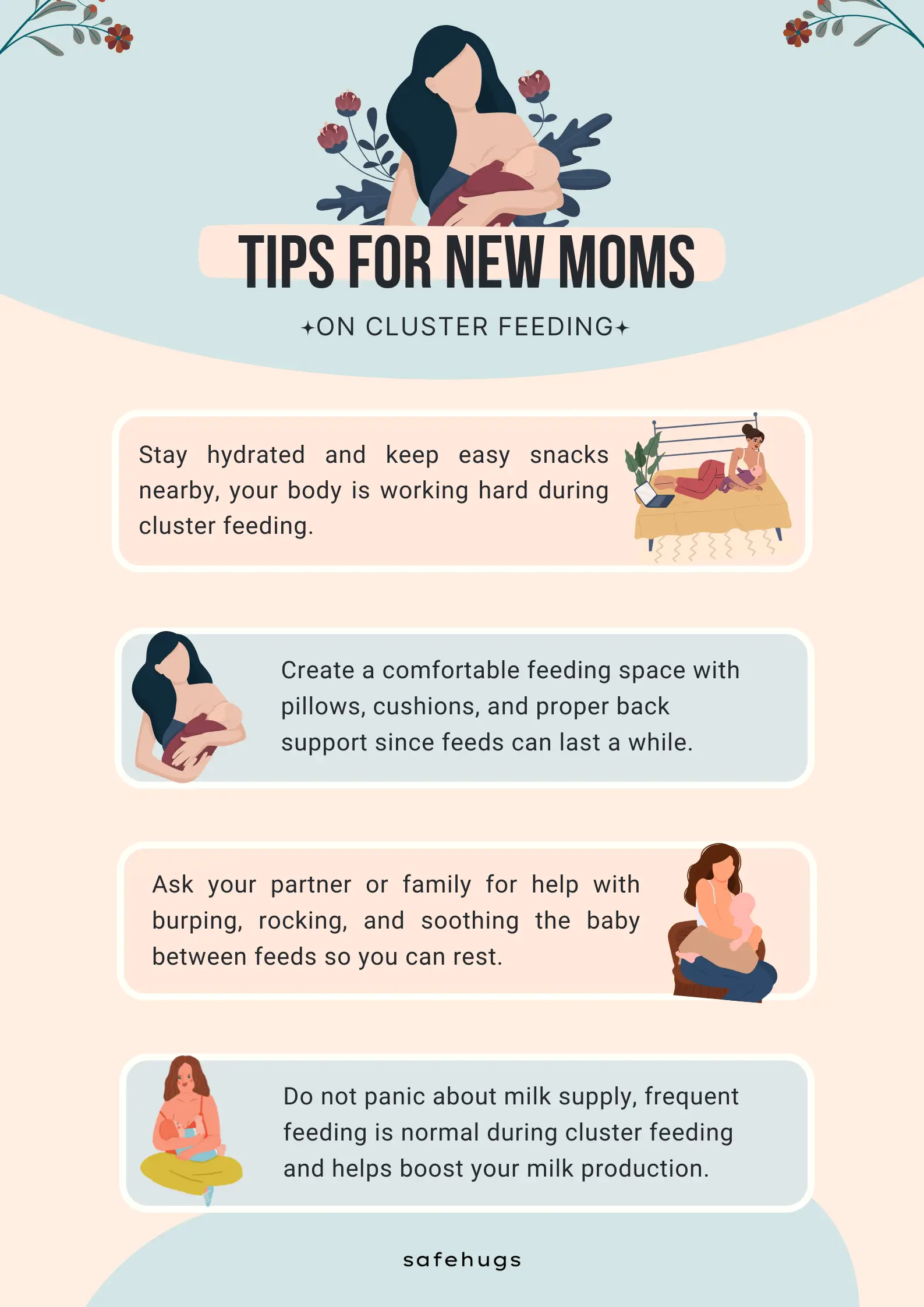
Stay hydrated and eat well. Your body is working hard. Keep water, snacks, and easy meals within arm's reach. Drinking enough fluids is especially important for milk production.
Get physically comfortable. Use a recliner, nursing pillow, or a stack of cushions to support your back and arms.
Entertain yourself. Binge a show, listen to podcasts or music, or call a friend. This is not laziness, it is part of your survival and it is completely valid.
Use skin-to-skin contact. Holding your baby skin-to-skin between feeds is soothing for both of you. Many moms in our Mom Insider community found their babies settled into a calmer, deeper sleep with skin-to-skin, particularly in the first three months.
Share the load. Have your partner, mother, or mother-in-law take over burping, settling, and soothing between feeds. Even 20 minutes of hands-free time can make a difference.
Take mini breaks. Step out for fresh air when someone else can hold the baby. Even a short walk, a cup of tea, or ten minutes outside can reset your mental state.
Don’t try to be happy all the time. It is okay to find this hard. It is okay to feel frustrated, and exhausted. And it is okay to ask for help.
Takeaways
Cluster feeding is one of the hardest phases of early motherhood. It is never ending, exhausting, and deeply isolating, especially when the people around you are misreading it as something being wrong with you or your baby. But the truth is your baby is growing. Your body is responding. The two of you are figuring each other out, feed by feed, hour by hour. And every mother who has sat in that chair at 11pm, then midnight, then 1am, and made it through, will tell you the same thing. It passes. Use every bit of support available to you. Ask partner to step in. Trust your instincts and continue to do what you are doing.
Related:
Check out "Signs of Cluster Feeding".
Check out "Wrong Breastfeeding Positions".
Check out "Why Is My Newborn Gagging While Sleeping".
Check out "Signs of Overfeeding Newborn".