Signs of Cluster Feeding: Everything You Should Know
By the time your baby arrives, you are mentally prepared for all the struggles that come with being a mother. You might have fed the baby 20 minutes ago, but now they are crying for milk again. No matter how many times you have fed, consoled, this might feel like never ending. You may think your milk supply might have dropped or you are doing something wrong. But you are not. What you're experiencing is cluster feeding and it is most common. Here we will help you understand what it is, signs of cluster feeding and how to get through it.
Table of Content
What Is Cluster Feeding?
When Does Cluster Feeding Happen?
Signs of Cluster Feeding in Babies
Signs It Is NOT Cluster Feeding
Why Do Babies Cluster Feed?
Tips to Manage Cluster Feeding
Common Myths About Cluster Feeding
What Is Cluster Feeding?
Cluster feeding is when your baby feeds multiple times in a short period, sometimes every 20 to 40 minutes, usually within a stretch of a few hours. Instead of the usual gaps between feeds you might have expected, your baby seems to want to be on the breast almost all day. It is different from regular on-demand feeding where the feeds are together, shorter in duration, and tend to happen at a specific time of day, mostly in the evenings. And here is the most important thing to know upfront: cluster feeding is not a sign that your milk supply is low. It is actually one of the ways your baby tells your body to make more milk. More on that in a bit.
When Does Cluster Feeding Happen?
Cluster feeding does not follow a strict timetable. It can happen at any stage, with any baby. That said, it tends to peak during growth spurts, which commonly occur:
In the first few days after birth
Around 3 weeks
Around 6 weeks
Around 3 to 4 months
A mom from our Mom Insider community mentioned that the growth spurt doesn't have a timetable and her baby started cluster feeding after 3 days. Evening hours are the most typical time for cluster feeding, many moms find that their babies are calm during the day but feed almost constantly from late afternoon into the night. However, some babies do it during the day with longer stretches at night, which, while tiring, can actually work in your favour for sleep.
Growth Spurts - Short periods of rapid growth when babies feed more often, become fussier, and may sleep differently to support their increasing nutritional needs.
Signs of Cluster Feeding in Babies
Here are the key signs to look out for:
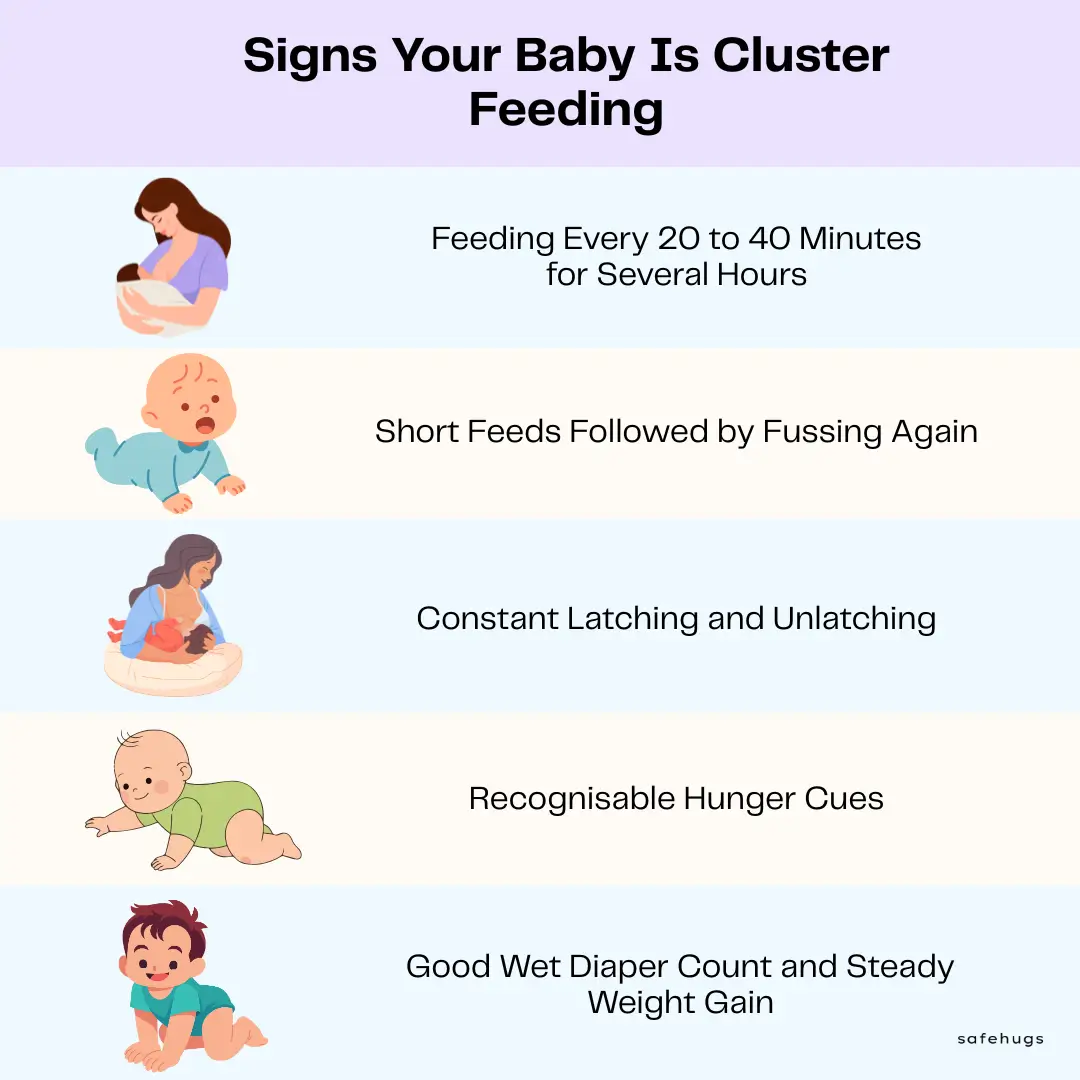
1. Feeding Every 20 to 40 Minutes for Several Hours
The most obvious sign. If your baby is latching on every half hour or so, and this goes on for a few hours at a stretch, that is classic cluster feeding.
2. Short Feeds Followed by Fussing Again
Your baby feeds for 10 minutes, seems content, and then 20 minutes later is rooting and crying again. The feeds feel incomplete, but baby keeps coming back for more.
Rooting Reflex - It is a natural newborn reflex where a baby turns their head and opens their mouth when their cheek or mouth is touched.
3. Constant Latching and Unlatching
During a cluster feed, your baby may latch, feed for a bit, unlatch, fuss, and then want to latch again. This can be frustrating and confusing, but it is very common. A mom in our community mentioned, "She feeds for 4-5 times till she sleeps and each feed is not more than 10 mins. In the last 2-3 times she is very cranky, latches and unlatches continuously."
Struggling with painful feeds or a poor latch? Learn the common wrong breastfeeding positions and how to fix them.
4. Baby Is Calm Between Feeds (But Wants the Breast Again Soon)
A cluster feeding baby is generally content and soothed at the breast. If your baby calms down when offered the breast but fusses again shortly after, that is a strong indicator of cluster feeding rather than colic or illness.
5. Recognisable Hunger Cues
Your baby will show hunger cues repeatedly throughout the cluster feeding phase:
Rooting - turning their head and searching for the nipple
Sucking on hands and fingers
Lip smacking
Crying - this is usually a late hunger cue, after the earlier ones are missed
6. Good Wet Diaper Count
Even during cluster feeding, if your baby is having 6 to 8 wet diapers a day, your milk supply is doing its job. This is one of the most obvious signs that your baby is getting enough.
7. Steady Weight Gain
Babies who are cluster feeding usually gain weight well because they are feeding frequently and effectively, even if each individual feed feels short.
8. Evening Fussiness Paired With Constant Hunger
If your baby is mostly settled during the day but becomes fussy and feed-hungry in the evening hours, cluster feeding is very likely the cause. This is so common it is almost a rite of passage for new mothers.

Signs It Is NOT Cluster Feeding
Not every period of frequent feeding or fussiness is cluster feeding. Here are signs that something else may be going on:
Baby is inconsolable even after breastfeeding
Poor weight gain or very few wet diapers, it could indicate supply or latch issue
Baby arches their back and seems to be in pain after every feed. It could be due to reflux. A mom from our community noticed that constant cluster feeding combined with bottle top-ups led to overfeeding and reflux.
Crying that last more than an hour with no relief at all
Unusual behaviour alongside feeding changes
Why Do Babies Cluster Feed?
Understanding the why makes it a little easier to get through.
1. Growth Spurts
During a growth spurt, your baby needs more calories. Cluster feeding is their way of getting them. It is perfectly in sync with their developmental needs.
2. To Boost Your Milk Supply
Breast milk works on a supply-and-demand basis. The more your baby feeds, the more your body is signalled to produce. Cluster feeding, especially in the newborn phase, is one of the most powerful ways to establish and increase your supply. This is why jumping straight to formula during a cluster feeding phase can sometimes work against you.
3. Comfort and Closeness
Babies do not only feed out of hunger. The breast is also a source of comfort, warmth, and security. Sometimes cluster feeding is as much about needing you as it is about needing milk.
4. Adjusting to the Outside World
Newborns have just left the only environment they have ever known. Being close to you, feeding frequently, and feeling your warmth helps them adjust. Skin-to-skin contact during this phase can be incredibly soothing for both of you.
How Long Does Cluster Feeding Last
This is the question every mom wants an answer. The honest answer is: it depends, but it does end. A single cluster feeding phase during a growth spurt usually lasts 2 to 5 days. However, because growth spurts happen at multiple stages in the first few months, you may experience cluster feeding more than once. By around 3 to 4 months, most babies have bigger stomachs, more efficient feeding, and better established supply, which means cluster feeding naturally becomes less intense.
Tips to Manage Cluster Feeding
You cannot really stop cluster feeding, and you would not want to, because it is doing important work. But you can make it more manageable.
Accept the phase and go with the flow. Fighting it or trying to stretch out the gap between feeds will just lead to more crying and stress.
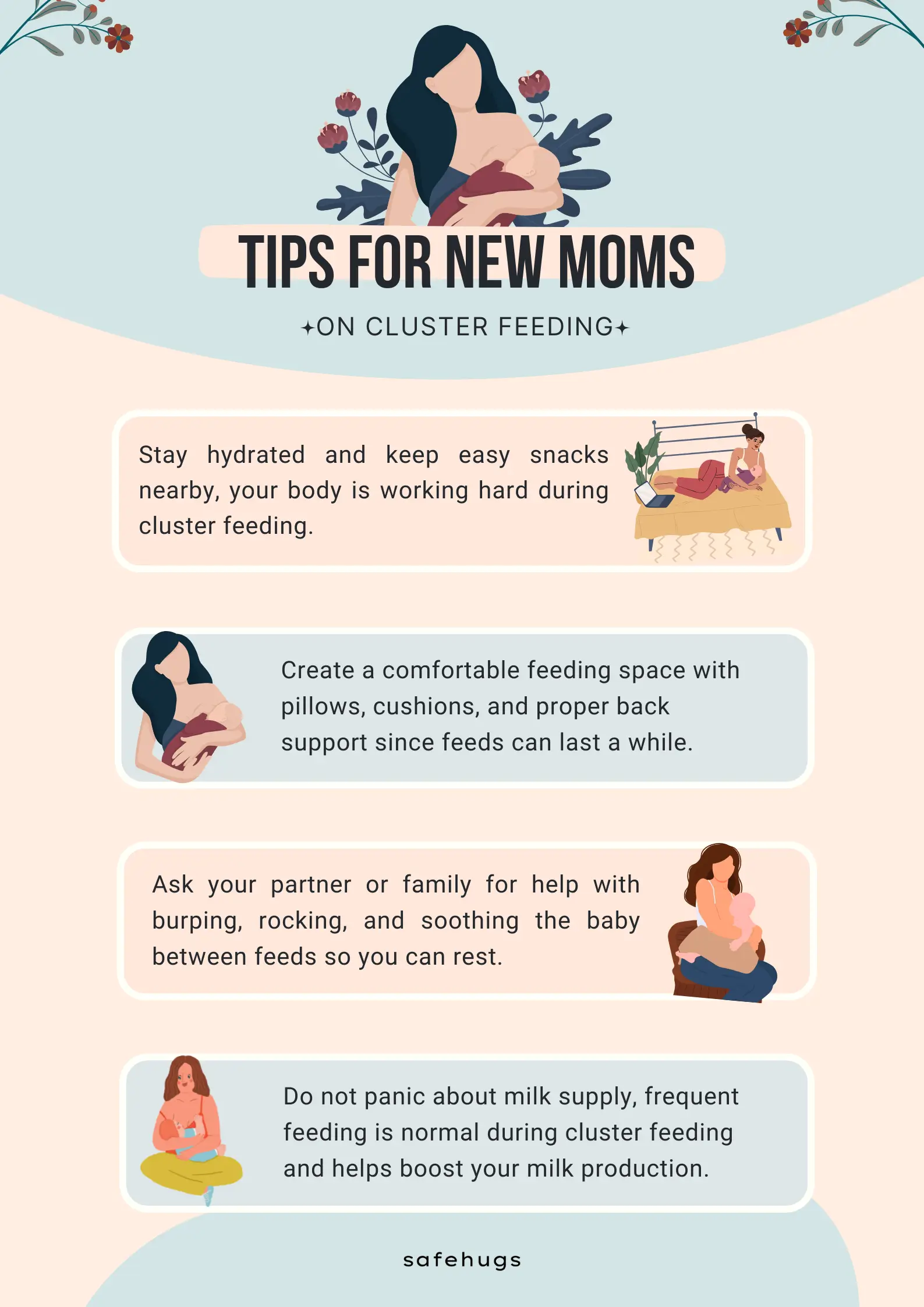
Stay hydrated and eat well. Your body is working hard. Keep water and snacks within reach at all times.
Get comfortable. Invest in a good nursing pillow, use a recliner if you have one, and surround yourself with cushions. You may be there for a while. One mom shared that she got a recliner for this purpose so she could feed the baby easily.
Entertain yourself. Many moms in our group got through cluster feeding by bingeing shows, listening to music or podcasts, or scrolling through their phones. There is no guilt in this. Do what keeps you sane.
Ask for help. Have your partner, mother-in-law, or a family member take over burping, soothing, and rocking between feeds. One practical suggestion from our Mom Insider community is to pump breast milk so your partner can give one feed at night while you sleep a solid stretch.
Skin-to-skin contact. Holding your baby skin-to-skin between feeds can soothe them and reduce the intensity of cluster feeding. Multiple moms in our group swore by this, with one saying she did skin-to-skin until her baby was 3 months old.
Do not panic about your milk supply. The urge to supplement with formula when cluster feeding is understandable, but if possible, hold off. As one mom from our community mentioned that supplementing led to overfeeding and reflux in her baby, and a dip in her own supply. If your baby has good wet diapers and is gaining weight, your supply is just fine.
If you do supplement, protect your supply. If you decide formula is necessary, try to continue breastfeeding, especially at night, when your milk-producing hormones are most active.
Common Myths About Cluster Feeding
Myth: My milk supply must be low.
This is the most common and most unhelpful thing people say during cluster feeding. Your supply is almost fine. Cluster feeding is what builds supply, not a sign of its absence.
Myth: I am overfeeding my baby.
As one mom in our group correctly pointed out: "You can never overfeed through breast." Breastfed babies regulate their intake naturally. Overfeeding is more of a risk with bottle feeding.
Myth: Something is wrong with my baby.
Nothing is wrong. Your baby is doing exactly what they are biologically designed to do.
Myth: Formula will solve it.
Formula may fill your baby up for longer since it digests more slowly, but it does not address the underlying growth spurt or supply-building that cluster feeding is doing. It can also lead to a drop in your milk supply if it replaces too many breastfeeding sessions.
Takeaways
Cluster feeding is one of the most exhausting, confusing, and misunderstood parts of early motherhood. It can make you question your supply, your choices, and your sanity, especially at 3 am. But here is the truth that every mom on the other side of it will tell you: it is temporary, it is purposeful, and you will get through it. As one mother in our Mom Insider community said: "It's honestly a very brutal stage. Just gotta keep swimming and stay afloat during this tough phase."
Related:
Check out "How to Start Breastfeeding After a C-Section".
Check out "Wrong Breastfeeding Positions".
Check out "Baby Feeding Chart (0-12 Months)".
Check out "Signs of Overfeeding Newborn".